
If you’ve ever wondered whether your baby is communicating “on track,” you’re not alone. Most parents have that quiet worry at some point.
This article breaks down the 16 gestures by the 16 months milestone: what it means, why it matters, and how to support your baby at home.
You’ll find a full gesture list, a checklist, and practical tips you can start using today.
Gestures are the foundation of early communication. By the end, you’ll know exactly what to look for and what to do next.
What Are the 16 Gestures by 16 Months Milestone?

Before babies say their first words, they talk with their hands. The 16 gestures by 16 months milestone tracks how many intentional gestures a baby uses by the time they turn 16 months old.
Gestures come before speech. When a baby waves, points, or shakes their head, they are actively communicating.
Research shows that babies who use more gestures early on tend to develop stronger language skills later. A gesture is not just a cute trick. It is a real communication tool.
Every time a baby points at something or raises their arms to be picked up, they are practicing the back-and-forth of conversation.
These small acts build the brain pathways that support speech, social connection, and learning.
Gesture development begins around 9 months and builds steadily through 16 months.
By 16 months, most babies should have at least 16 gestures in their toolbox, from simple ones like waving to more expressive ones like shrugging “I don’t know.”
Complete 16 Gestures by 16 Months List (Month-by-Month)

Here is a full breakdown of the gestures babies typically learn and when they tend to appear.
9 Months
Your baby is starting to communicate with purpose – and it’s just the beginning
Give: Your baby holds out an object and releases it into your hand. This shows early sharing and intentional communication.
Shake head: A side-to-side head shake to signal “no.” This is one of the first ways babies express disagreement or refusal.
10 Months
Every reach and lift is your baby finding their voice before words arrive.
Reach: Your baby extends their arm toward something they want. This gesture shows desire and intentional communication.
Raise arms: Lifting both arms up toward a caregiver signals “pick me up.” A clear and purposeful request.
11 Months
Social skills are blooming as your baby learns to connect and share moments with you.
Show: Your baby holds up an object to show you, not to hand it over. They want you to look and share the moment.
Wave: A classic gesture. Waving hello or goodbye is a social milestone that shows your baby understands greetings.
12 Months
Around the first birthday, gestures get more specific and intentional than ever.
Open-hand point: Pointing with an open hand or all fingers extended. This usually comes before the more precise index finger point.
Tap: Tapping on an object or surface to draw attention to it. Babies use this to say “look at this” without words.
13 Months
Your baby is discovering the joy of expression – and loving every reaction they get.
Clap: Clapping is often used to express excitement or approval. It is also a social gesture that mirrors what caregivers do.
Blow a kiss: A playful and affectionate gesture. Babies learn this through imitation and love the reaction it gets.
14 Months
This month brings some of the clearest signs yet that your baby wants to connect with you.
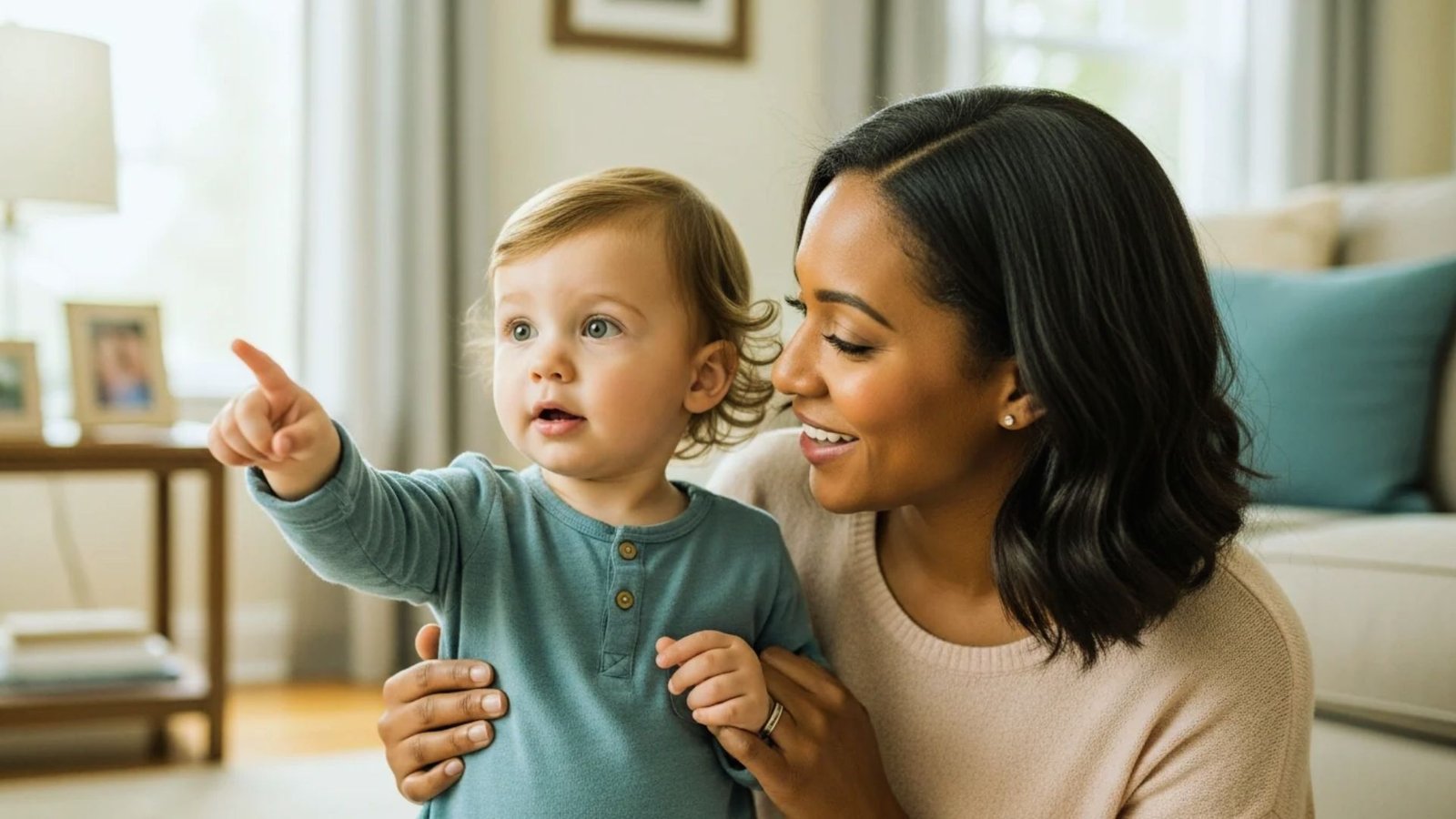
Index finger point: Pointing with one finger is a major milestone. It shows the baby can direct attention and share interest with another person.
“Shhh” gesture: Putting a finger to the lips to signal quiet. This shows the baby is imitating social rules and understanding context.
15 Months
Your baby is not just reacting to the world anymore – they are actively participating in it.
Head nod: Nodding “yes” is a big step. It shows the baby understands affirmation and can use a gesture to agree.
Thumbs up: A gesture of approval or positivity, usually learned through imitation of adults and older children.
Hand up: Raising one hand, often used to signal “stop” or “wait.” This shows the baby is learning to use gestures to regulate interaction.
16 Months
By now, your baby has a whole repertoire of ways to say what they mean without a single word.
Other symbolic gestures: By 16 months, babies may add gestures like high five, shrugging “I don’t know,” or blowing out like a candle. These are more complex and show growing social awareness and creativity in communication.
16 Gestures by 16 Months Chart

A simple chart makes it easy to track which gestures your baby has learned and when.
Overview of Gestures by Age
The chart below gives you a quick visual of how gestures appear across months 9 through 16.
| Age | Gesture |
|---|---|
| 9 months | Give, Shake head |
| 10 months | Reach, Raise arms |
| 11 months | Show, Wave |
| 12 months | Open-hand point, Tap |
| 13 months | Clap, Blow a kiss |
| 14 months | Index finger point, “Shhh” gesture |
| 15 months | Head nod, Thumbs up, Hand up |
| 16 months | High five, “I don’t know,” and other symbolic gestures |
How Parents Can Use a Chart to Track Development
Print this chart and keep it somewhere visible, like on the fridge. Check off each gesture as your baby starts using it consistently.
If you notice large gaps or missing gestures, this chart can help you have a more focused conversation with your pediatrician.
16 Gestures by 16 Months Checklist for Parents

A checklist gives you something practical to work with week by week.
Monthly Gesture Tracking
Go through the list once a month starting around 9 months. Note which gestures your baby uses on their own, not just when prompted.
Spontaneous gestures carry more developmental weight.
Signs Your Baby is Meeting Communication Milestones
Your baby is on track if they are
- Using gestures with eye contact
- Combining gestures with sounds or words
- Adding new gestures each month
- Using gestures in different settings, not just at home
How a Checklist Helps Identify Early Delays
If your baby reaches 15 or 16 months and has fewer than 10 gestures, that is worth bringing up with your doctor.
Early identification leads to earlier support, which makes a real difference. A checklist is not a diagnostic tool, but it is a helpful starting point for tracking progress.
Tips to Support Early Communication at Home
Supporting your baby’s communication does not have to be complicated. Small, consistent habits make a big difference.
- When your baby looks at something, name it out loud. Follow their gaze and put words to what they are already paying attention to.
- Do not wait for your baby to talk. Celebrate every point, wave, and head shake. Gestures are speech in progress.
- Respond quickly when your baby reaches for something or makes a sound. A fast, warm response teaches babies that communication gets results.
- You do not need special activities. Wave at the mirror, point to food during meals, and clap during a favorite song.
- Model gestures every day. The more your baby sees you wave, point, and nod, the faster they will start doing the same.
Conclusion
Watching your baby wave for the first time or point at something they love is one of those moments that catches you off guard. It is small, but it means so much.
The 16 gestures by 16 months milestone gives parents a clear and practical way to support early communication. You do not need to wait for words to know your baby is connecting with the world.
If this guide helped you, share it with another parent or leave a comment below. And if you want more baby development content, check out our related posts on early language milestones.
Frequently Asked Questions
What if my child has fewer than 16 gestures by 16 months?
Talk to your pediatrician. Fewer than 16 gestures can be an early sign of a communication delay, and getting support early through speech therapy can make a real difference.
Do all babies use the same gestures?
Not exactly. Most babies learn similar gestures like waving and pointing, but timing and order can vary based on the child, the home environment, and cultural context.
Can gestures replace spoken words?
No. Gestures are a stepping stone to speech, not a replacement. Most babies naturally move from gestures to words between 12 and 24 months.
What do parents say on Reddit about gesture delays?
Many parents share concerns about babies who are not pointing by 12 to 14 months. Common topics include when to seek evaluation and experiences with early intervention programs.
How can I tell if my baby’s gestures are intentional?
Look for eye contact. When a baby points and then looks back at you, that is intentional communication. Gestures paired with eye contact and a pause for your response are strong signs.