

Many parents notice at bath time or in a photo taken from above that one side of their baby’s head looks flatter, and the next worry is usually when does baby head shape become permanent and whether it will stay that way.
Head shape stays adjustable for a long time because of how a baby’s skull is built.
Nationwide Children’s Hospital notes that it can take 9 to 18 months for a baby’s skull to be fully formed.
That flexibility is why mild flattening often rounds out as your baby learns to roll, sit, and crawl.
Below, you will find what to watch for at each age up to 24 months and which signs are worth raising with your pediatrician.
How Does a Baby’s Head Shape Change With Age?
A baby’s head shape does not become permanent at a set age, because the skull stays soft and keeps growing through the first year and beyond.
The bony plates are not joined at birth, and Texas Children’s Hospital notes that the soft spot at the top of the head usually closes between 7 and 19 months .
This flexibility lets steady pressure flatten an area and lets a change in position round it out again.
The NHS says most flat spots need no treatment and often ease over the first one to two years as babies grow and spend more time upright.
Thicker hair also hides mild differences, so the outcome depends on the starting shape and how early a concern is checked.
When Do Babies’ Heads Round Out?
Most head shape changes follow a loose timeline that tracks how much a baby moves. The stages below describe what is typical at each age and when a check makes sense.
Baby Head Shape Changes From Birth to 6 Weeks
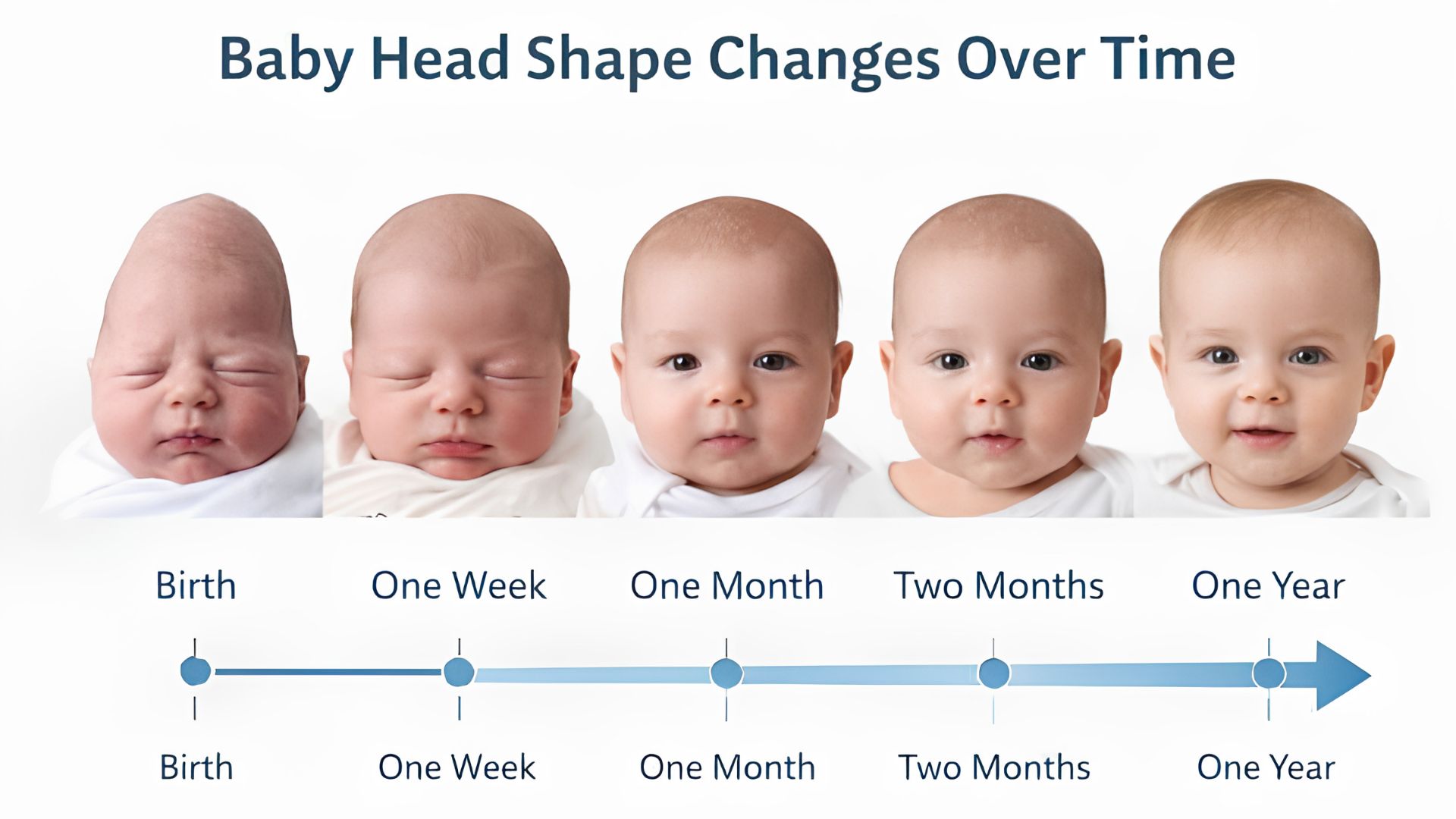
Pressure during delivery can leave a newborn’s head slightly elongated or uneven, and some temporary swelling and molding is common in the first days.
Nationwide Children’s Hospital explains that it is normal for a baby’s head to look a little misshapen for a few weeks, and rounding out can take days or even weeks.
Babies who spent the end of pregnancy in a cramped position may also be born with a flat area, which the pediatrician will look at during routine newborn visits.
Baby Head Shape Changes From 2 to 4 Months

Positional flattening is most likely to appear in this window, because babies spend most of the day on their backs and cannot yet roll or shift on their own.
A baby who always turns toward the same side keeps resting on the same spot, and once a flat area forms, it becomes easier for the head to settle back into it.
Checking head shape at bath time and mentioning any change at the next well-baby visit helps catch a flat spot early, when simple repositioning has the most effect.
Baby Head Shape Changes From 4 to 6 Months

Most babies gain head control, push up on their arms, and begin to roll during these months, so pressure moves away from the back of the head.
An existing flat spot may start to improve, although it can persist if the baby keeps favoring one side.
A pediatrician can assess the shape if it is not improving, if one ear or one side of the forehead looks shifted, or if your baby has trouble turning the head in both directions.
Baby Head Shape Changes From 6 to 12 Months

Sitting, crawling, and pulling up to stand take most of the pressure off the back of the head.
Children’s Health Queensland notes that a flat spot usually corrects itself by the time a baby sits independently.
If one side still looks flatter, or the face and ears look uneven during the second half of the first year, that pattern is worth raising with your child’s doctor.
Baby Head Shape Changes From 12 to 24 Months

Growth continues, and hair thickens, which makes mild flattening harder to see.
The NHS states that flat head syndrome often improves over 1 to 2 years as your baby’s head grows
Because the skull firms up with age, it is better to ask your pediatrician about a persistent concern than to wait and see, since doctors generally prefer to assess it early.
What Causes a Baby’s Head Shape to Become Uneven?
An uneven head usually comes from pressure on the soft skull, either before birth or in the early months, and only rarely from a problem with how the skull plates join.
Common reasons include:
- Position in the womb: A crowded uterus, low amniotic fluid, or more than one baby in the same pregnancy can press on the head before birth.
- Delivery: A long labor or the use of forceps or a vacuum can put pressure on the skull.
- Premature birth: Babies born early have softer skulls and often spend more time lying on their backs.
- Time spent in one position: Back sleeping, which is the safest position for sleep, combined with long stretches in car seats, swings, and bouncers can keep pressure on the same spot.
- Torticollis: Tight neck muscles can make a baby rest the head on the same side and limit how far it turns.
- Craniosynostosis: In rare cases, one or more skull sutures close too early and change the head shape from birth.
Will a Baby’s Flat Head Correct Itself Naturally?
Yes, mild positional flattening often corrects itself without treatment. The NHS says flat head syndrome usually improves on its own and does not affect a baby’s brain or development.
As your baby learns to roll, sit, and crawl, the head spends less time pressed against a surface, and the skull fills in the flatter area while growing hair hides what is left.
Moderate or severe flattening is less predictable, so a pediatrician or craniofacial specialist should judge whether the shape is changing.
Helmets are not provided by the NHS because evidence that they work is limited, so any decision about them belongs with your child’s doctor. If torticollis is the cause, gentle stretching from a physical therapist helps.
How to Improve Baby Head Shape Safely

The goal is to take pressure off the flat area during the day while keeping every sleep exactly as safe as before.
The American Academy of Pediatrics (AAP) advises placing babies on their backs for every sleep, including naps, and that advice does not change when a flat spot appears.
Most of the work happens while your baby is awake and being watched:
- Tummy time: Offer supervised tummy time every day while your baby is awake, starting from the first day’s home, and place a toy or your face within reach so your baby lifts and turns the head.
- Position changes: Vary how you carry and feed your baby, and hold your baby upright against your shoulder or in a carrier for part of the day.
- Toys and mobiles: Place them so your baby turns toward the side that is not flat.
- Less time in gear: Limit long stretches in car seats, swings, and bouncers, and take your baby out of the car seat once you arrive.
Sleep needs more caution than daytime play. When you lay your baby down on their back, you can gently turn the head toward the side that is not flat, as long as it does not wake your baby each time.
Never use anything to hold the head in place, since Nationwide Children’s Hospital warns it can block the face and make breathing harder, and keep to the firm, flat sleep surface without soft bedding that the AAP recommends.
If your baby has trouble turning the head in one direction, mention it to the pediatrician, because physical therapy for torticollis can make repositioning easier.
Signs Your Baby’s Head Shape Needs Medical Attention
Positional flattening and craniosynostosis can look alike at first, but they differ in cause and in how they are managed.
Knowing the signs of each helps you describe what you see when you speak to a doctor, who makes the diagnosis.
Signs of Positional Head Flattening
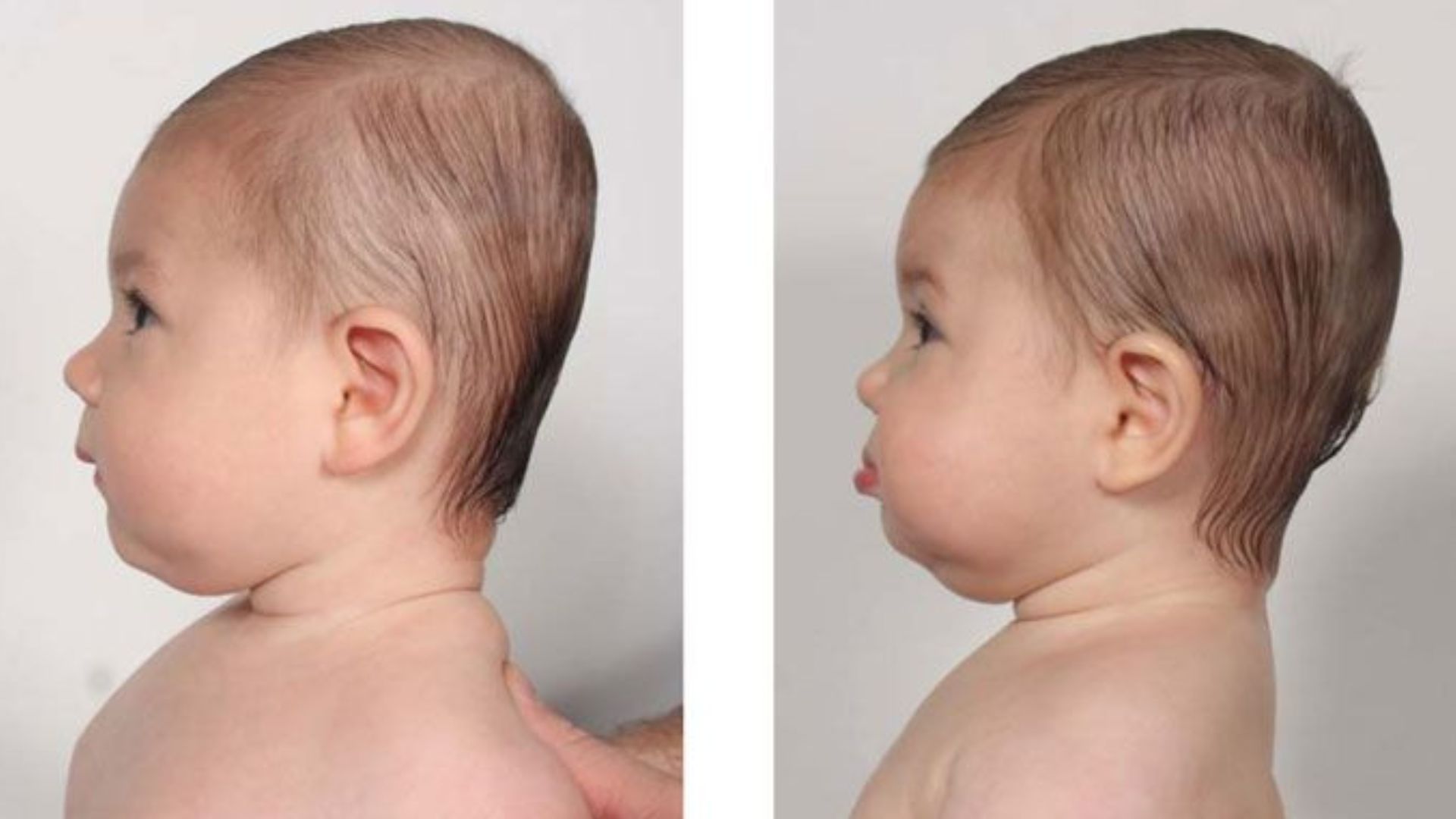
Positional flattening usually shows as a flat area at the back or on one side of the head.
When it affects one side, one ear may sit farther forward, one side of the forehead may look more prominent, and the head can look like a parallelogram when viewed from above.
When the whole back of the head is flat, the head may look wide. Your baby feels no pain from it, and the skull feels smooth rather than rigid.
Signs of Craniosynostosis
Craniosynostosis is a rare condition in which one or more skull sutures close too early.
The Mayo Clinic explains that signs of craniosynostosis are usually visible at birth and become clearer over the first few months, including an unusual head shape, a raised, hard ridge along a suture, and uneven facial features.
A different head shape does not always mean craniosynostosis, but early diagnosis matters because treatment is usually surgery, and untreated cases can raise pressure inside the skull.
When Should You Call a Pediatrician About Your Baby’s Head Shape?

Call your pediatrician whenever your baby’s head shape worries you, and do not wait for the next routine visit if you notice any of the following:
- Flattening that persists or gets worse
- Noticeable unevenness in the forehead, ears, or face
- Limited neck movement or a head that stays tilted to one side
- An unusual skull shape present from birth
- A hard ridge along a suture or an unusual head growth pattern
- A shape that is not improving over time
Most flat spots are harmless, but a quick check gives you a clear answer and an early plan if one is needed.
This article is for general information and does not replace advice from your child’s doctor.
Final Takeaway
When does baby head shape become permanent? Not on a set date. Most mild flat spots ease as your baby moves more, and your pediatrician can tell you if yours needs a closer look.
I know it is hard not to worry, but daily supervised tummy time, new positions while your baby is awake, and back sleeping for every sleep all help.
A head that stays tilted, a hard ridge along a suture, or flattening that gets worse needs a doctor’s look sooner.
At your next well-baby visit, ask your pediatrician to check your baby’s head shape, even if it looks mild.
Frequently Asked Questions
Is 4 months too late to fix a flat head?
No. At 4 months the skull is still soft, so tummy time and repositioning still help. If a helmet is advised, it’s usually started at 4-6 months, and that decision is best made with your child’s doctor.
Can you still shape a baby’s head at 3 months?
Yes, the skull is still soft at 3 months. Supervised tummy time and repositioning can sometimes be enough to correct the shape before 4 months.
Can you shape a baby’s head with your hands?
No. There is no evidence that pressing on or massaging a baby’s head makes it round, and too much pressure can hurt. Use tummy time and position changes instead.