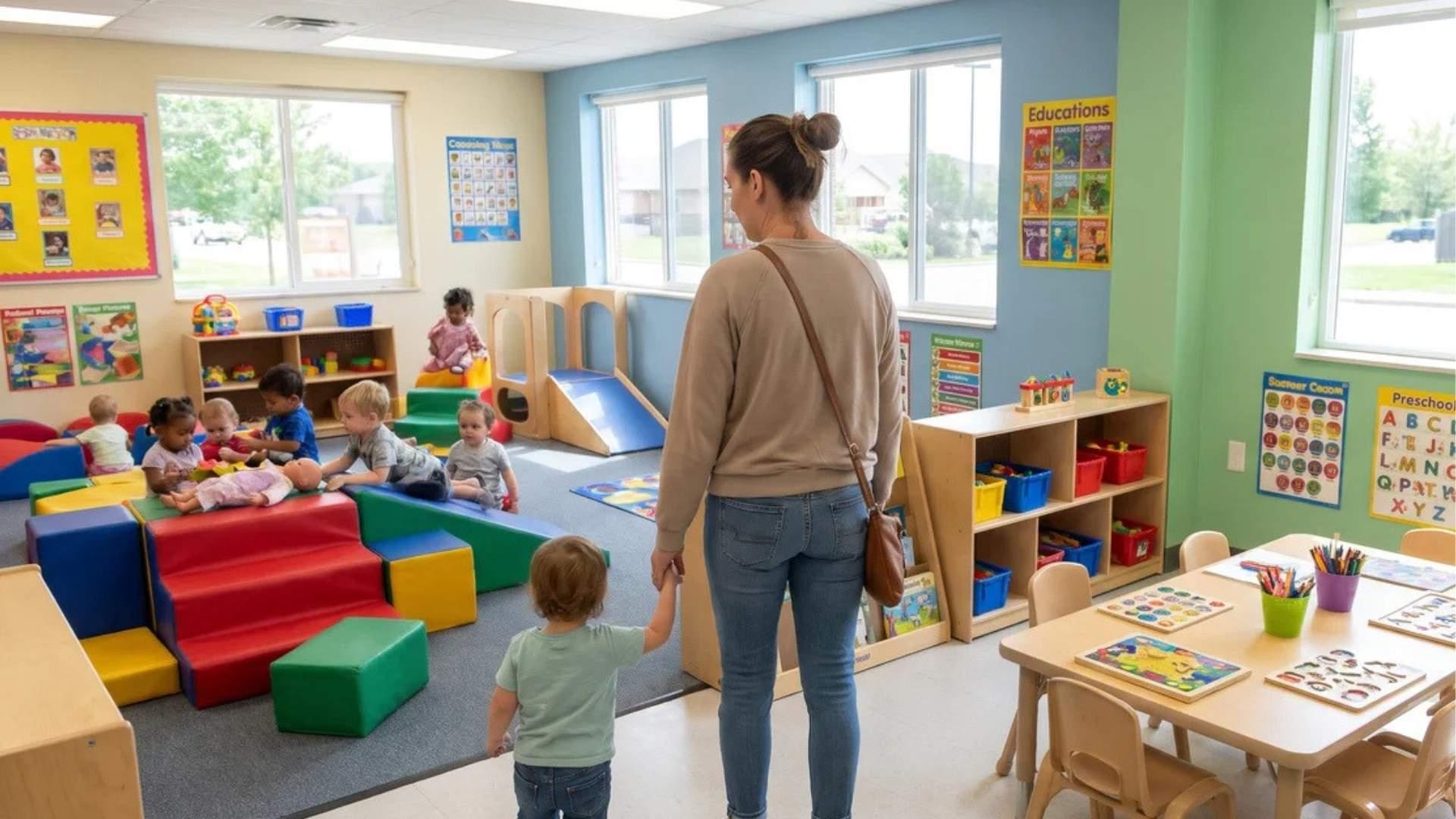



You walk out of a daycare tour with a bright playroom in your head and a nagging doubt you can't name.
That doubt often comes from questions the tour never answered, like how many children each caregiver handles.
One detail changes the whole search: A license shows a program meets your state's minimum standards, and the staffing levels experts recommend are a separate benchmark.
Knowing how to choose a daycare means comparing options on facts instead of first impressions.
Before you compare any facility, though, it helps to get your own priorities straight.
How to Choose a Daycare That Fits Your Family's Needs
Choosing a daycare involves finding a childcare setting that meets your child's needs, fits your family schedule, and provides a safe and supportive environment.
A good fit works on two levels.
The program has to suit your child's age, temperament, and stage of development, and it also has to work with your commute, your hours, and your budget.
A center that scores well on one level and poorly on the other leaves you with a trade-off, so it helps to weigh care quality, safety, caregiver relationships, and practical requirements together.
Some centers also use cameras as a selling point, so it’s worth knowing what daycare video monitoring policies usually cover.
The search itself follows five steps:
- Identify your needs: Your child's age, your schedule, and your budget
- Research facilities: Programs in your area that fit those needs
- Verify standards: Check each program against your state's requirements
- Visit programs: The ones that hold up on paper
- Compare options: Side by side, using the same criteria
The first step is the most personal one, and it starts with your own schedule, budget, and timeline.
What Should You Consider Before Requesting Daycare Placement?

Common triggers include a return to work, gaps in your schedule, limited help from relatives, or a need for consistent supervision, and each points toward a different kind of care.
How Your Work Schedule and Family Budget Affect Placement
Your work hours and commute set the outer limits of your search. A daycare that closes at 5:30 p.m. does not help if your commute ends at 6:00.
The budget narrows the list further, because tuition is only part of the cost. Registration fees, late-pickup charges, and sibling discounts all change the real monthly total.
The U.S. Department of Labor's National Database of Childcare Prices lists county-level median prices by provider type and child age (2022 data), which helps you judge whether a quote is typical.
How Your Child's Age and Developmental Needs Affect Care
Infants, toddlers, and preschoolers need different routines, so age shapes the whole search.
Infants depend on caregivers for feeding and sleep on an individual schedule, while toddlers need room to move and early practice with social skills like taking turns.
Preschoolers spend more of the day in group activities and structured play.
Our guide to a daily schedule for 2-year-olds shows how a toddler's day revolves around meals, naps, and active play, a useful baseline for any facility's posted routine.
Parents deciding between structured learning and full-day care can look at preschool or daycare settings side by side.
When Should You Start Looking for Daycare?
Start before you need the spot. Where openings are limited, waitlists can run long. Contact programs well ahead of your start date and ask how their waitlist works.
Childcare.gov lists questions to ask each program at the start, including whether it is licensed, has space for your child, and what its hours and costs are.
With your needs written down, the next job is screening facilities against them, starting with the basics every program should meet.
What to Look for in Daycare When Comparing Facilities
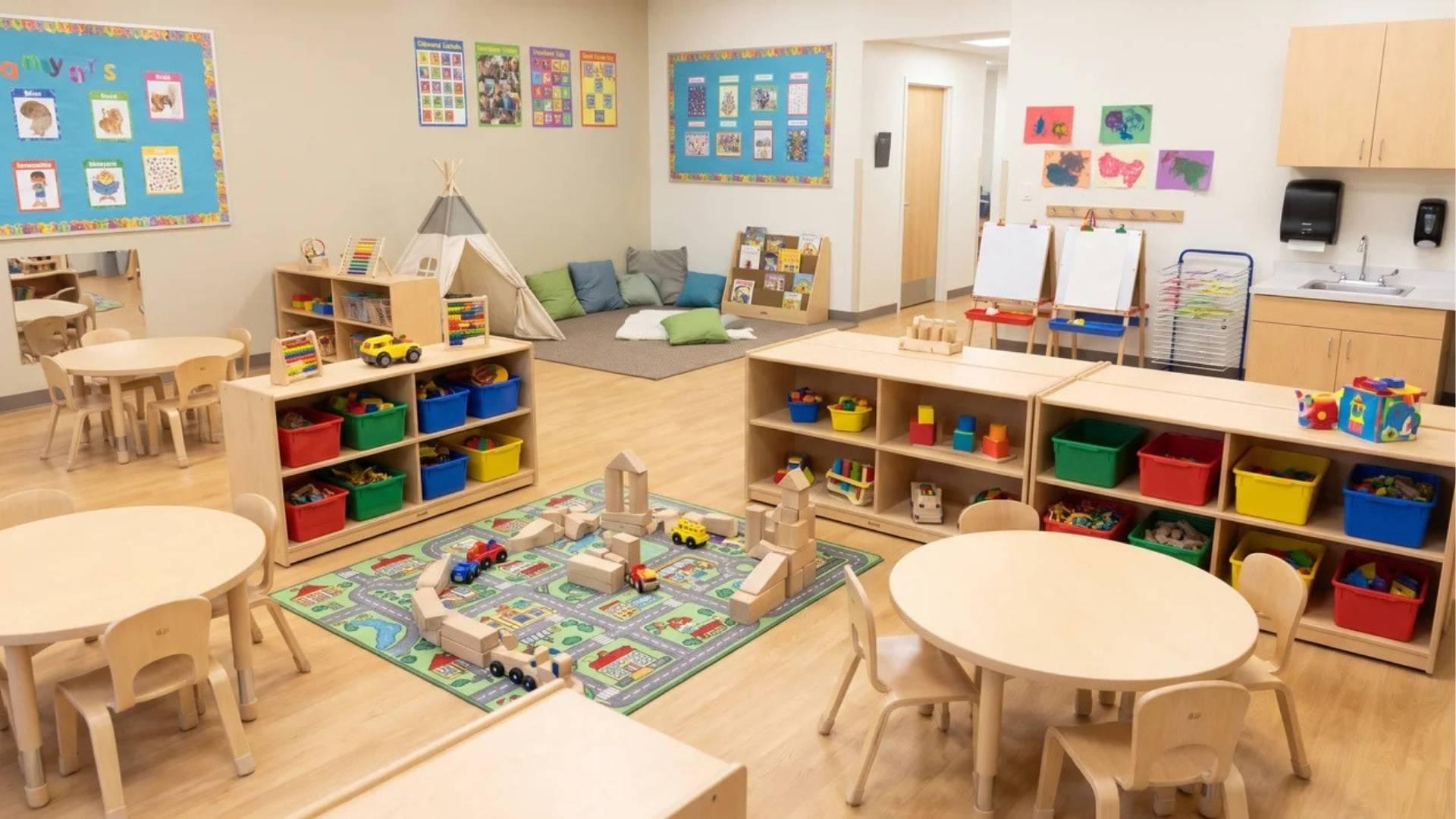
When deciding what to look for in daycare, begin with what you can verify before a visit, since appearances say little about how children are cared for day to day.
Public records, published standards, and straight answers from staff give you something solid to compare.
Licensing, Staff Qualifications, and Child-to-Staff Ratios
Every state sets its own licensing rules, so begin with your state's online child care search, which states and territories are required to offer.
There you can confirm a program's license status and read inspection reports, including violations and how they were corrected.
Some programs, such as public-school programs, may be legally license-exempt, so ask about their standards. Also ask what training the director and teachers have.
For staffing, ChildCare.gov lists recommended staff-to-child ratios for centers:
- Infants (under 12 months): No more than three per adult
- Toddlers (13 to 35 months): No more than four per adult
- 3-year-olds: No more than seven per adult
- 4-year-olds: No more than eight per adult
These are recommendations, not legal requirements. Required ratios vary by state, so compare them with your state's rules.
If your child is around 12 months old, ask the program which ratio applies, since the childcare.gov table doesn't list that age.
Safety, Cleanliness, and Daily Supervision
Safety shows up in routines you can check. For babies, ask whether the program follows NIH Safe to Sleep guidance at every nap.
That guidance recommends placing babies on their backs to sleep, on a firm, flat surface covered only by a fitted sheet, with soft objects and loose bedding kept out of the sleep area.
Beyond sleep, look at these during your research and your visit:
- How visitors enter and how children are released at pickup
- Whether rooms are clean and childproofed
- Whether the outdoor area is in good repair
- A written emergency plan, and caregivers who can see every child at all times
Caregiver Consistency and Developmental Support
Ask how long the lead caregivers have been with the program, because childcare.gov’s tip sheet lists high staff turnover as a question to raise.
Stable caregivers learn a child’s routines, which makes individual attention easier.
Watch how adults speak to children: at eye level, in a warm tone, and with a greeting for each child.
Programs also differ in approach, and a look at Montessori activities for 18-month-olds shows what hands-on, child-led play can involve.
Whatever the approach, a good daily plan mixes indoor and outdoor time with quiet and active periods.
Records and ratings only tell you so much about a facility. Seeing it on an ordinary weekday tells you the rest.
How to Evaluate a Daycare During an In-Person Tour

A daycare tour helps parents see how caregivers interact with children, how safety practices work, and whether the facility's daily routines match their expectations.
Visit while children and caregivers are in the middle of their normal routines, so you see the program as your child would experience it.
Childcare.gov offers free Look, Listen, and Ask tip sheets you can bring along.
What to Observe During the Daycare Visit
Start with the room. Check whether it is organized and clean, whether toys sit within children's reach, and whether play equipment, indoors and out, looks safe and in good repair.
Then watch the caregivers: They should greet each child, speak at the child's eye level, and keep a calm, positive tone.
Notice whether adults can see every child and whether handwashing happens often. Finally, look at the children.
Are they engaged in age-appropriate activities, and do they seem comfortable with the adults?
If you have an infant, check how long babies spend in swings and bouncy seats, since the tip sheet says children should spend most of their time playing on the floor.
Questions to Ask Daycare Staff Before Enrollment
Write down the answers so you can compare programs later:
- Staff turnover: How long have the current teachers been here, and how often do staff leave?
- Sick children: When must a child stay home, and how is medication handled?
- Behavior: How do caregivers respond to challenging behavior, including biting, and what is the discipline policy?
- Meals and naps: What is served, and how are individual schedules handled?
- Emergencies: What is the plan, and how are parents notified?
- Parent updates: How do you share details of the child's day, and can families drop in?
Ask for the family handbook as well, and compare its written policies on fees, pickup, and closures with what staff told you.
Specific answers that match the handbook are more reassuring than polished ones.
A few tours should leave you with a short list and a pile of notes. Sorting those notes into a decision is the last step.
How to Compare Daycare Options and Make Your Final Choice
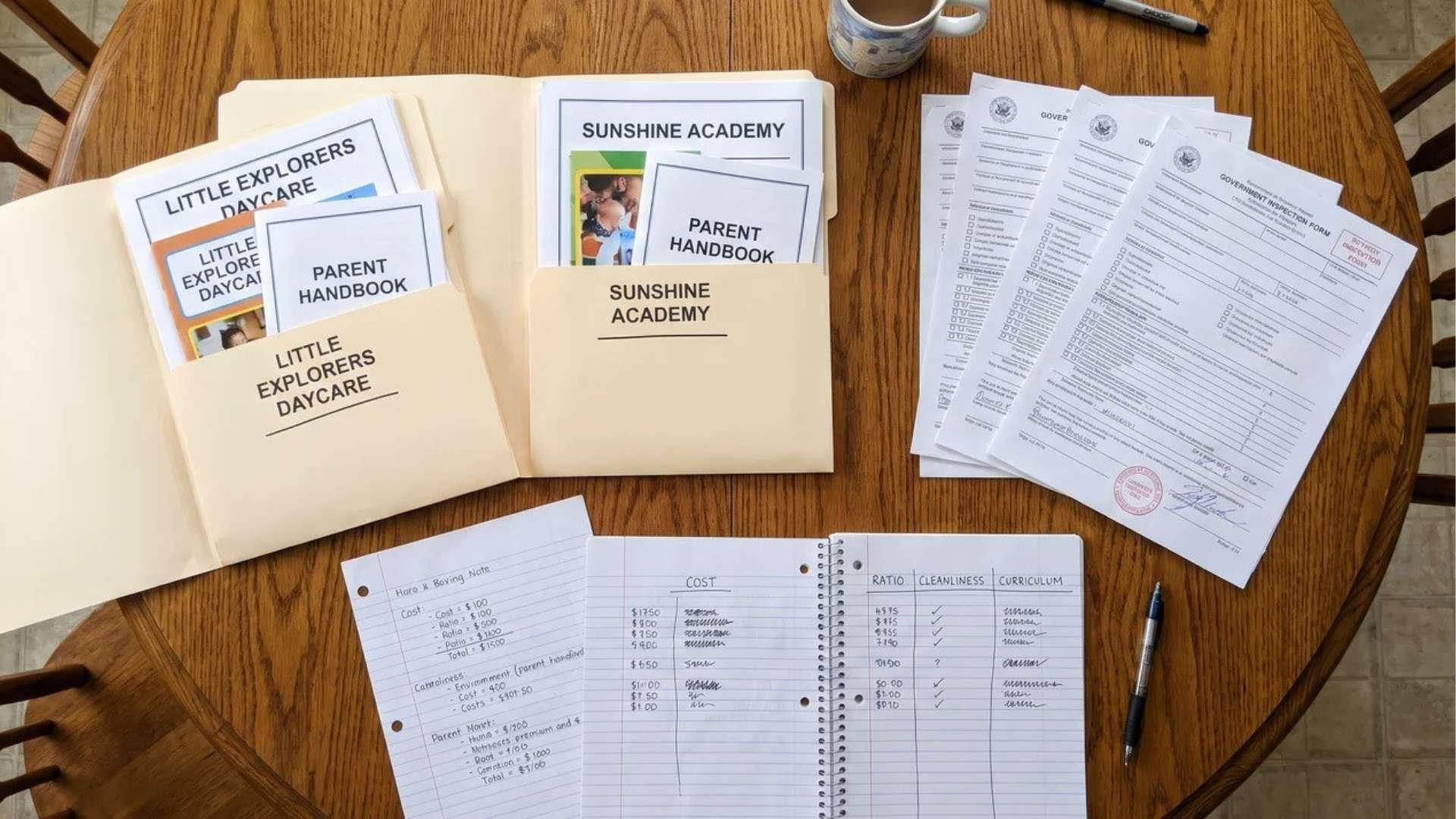
After a few tours, the options tend to blur together, and the one with the nicest room or the shortest drive can start to look like the obvious pick.
A fair comparison uses the same yardstick for every facility, and it puts verified facts ahead of price or location alone.
How to Weigh Daycare Quality Against Cost and Convenience
- Rate every facility on the same points: Score safety records, caregiver consistency, staffing ratios, developmental fit, location, hours, and total monthly cost for each program. One scale keeps a friendly tour from outweighing weaker records.
- Don’t let price or distance decide alone: A cheaper or closer daycare is not automatically the better pick, especially when supervision or caregiver stability looks weaker than at another option. Check how big the gap is before you trade care for convenience.
- Give safety and care the most weight: License status, inspection reports, and how long caregivers have stayed tell you more about daily care than the building does. Start your ranking here.
- Use cost and convenience as tiebreakers: When two programs look close on safety and care, let commute, hours, and total monthly cost separate them. Count registration and late-pickup fees in the cost, not just tuition.
- Add a gut check: Childcare.gov suggests asking how welcome you felt and whether the children seemed happy and engaged. Your impression matters, but it carries more weight once the facts back it up.
What to Confirm Before Enrolling Your Child
A good tour is not the same as a confirmed spot. Before you commit, get these details in writing:
- Actual openings and your child's start date, or your place on the waitlist
- Tuition, registration and late-pickup fees, and payment terms
- Operating hours and holiday closures
- Written policies on illness, discipline, and emergencies
- How and when staff will update you about your child's day
If you receive child care assistance, ask whether the program accepts those payments.
A few smaller questions tend to surface at this stage, so here are quick answers before you sign anything.
Final Takeaway on Choosing a Daycare
Knowing how to choose a daycare comes down to matching verified facts to your family's real routine, not finding the most polished building.
The unglamorous details, such as how many children each adult supervises and how long caregivers stay, tell you more about a program than its brochure does.
Trust the notes you took over the impression you formed in the lobby, and let the facts break any tie.
Search your state's online child care list this week and shortlist three licensed programs to visit.
Frequently Asked Questions
What Is a Good Age for Starting Daycare?
There is no single best age for starting daycare. The right time depends on your child's needs, your family's circumstances, and the program's caregivers and routines.
What Is the Difference Between a Daycare Center and In-Home Daycare?
Centers use classroom-style groups with several adults, while in-home daycare takes place in a provider's home with a smaller group. States regulate each differently, so check licensing for both.
What Should You Pack for Daycare?
Packing lists vary, so ask the program for its list first. Common items include spare clothes, labeled bottles, and diapers and wipes if the program does not provide them.
How Should You Introduce Your Baby to Daycare?
Share your baby's feeding, sleeping, and comfort routines with staff, and ask how they welcome new children. Short introductory visits that slowly grow longer help your baby get familiar with the caregivers.